Flat Feet: When Low Arches Cause Pain (and When They Don't)
Evidence last verified 2026-08-15 · pending SOLEMAX Medical Affairs review · 4 sources

Living with Low Arches and Daily Movement
Clinical ReferenceYou step out of the shower and notice that your wet footprint leaves a solid, complete outline on the bathmat with no hollow curve along the inside. Or perhaps after standing all afternoon on a hard concrete store floor, the inner edges of your arches and ankles feel deeply fatigued and achy.

The Core Question
Clinical ReferenceDo flat feet automatically lead to pain and posture problems, and does having low arches mean you always need arch support?
Flexible vs. Rigid Flat Feet: Understanding Your Arch
Clinical ReferenceYour foot contains three distinct arches, with the medial longitudinal arch along the inside of your foot being the most prominent. In human anatomy, arch height varies widely across the population—estimates suggest between 15% and 30% of adults have low or flat arches (pes planus). The crucial medical distinction is between flexible and rigid flat feet: • Flexible Flat Feet (Common & Normal): When you sit down or stand on your tiptoes, a clear arch appears. When you place your full body weight on the ground, the arch lowers to meet the floor. This is a normal, healthy anatomical variation. The bones and joints move freely, and in most people, flexible flat feet cause no pain whatsoever. • Rigid Flat Feet (Requires Evaluation): The foot remains completely flat whether you are sitting, standing, or on tiptoes, and the joints feel stiff or immobile. Rigid flat feet can stem from congenital bone bridges (tarsal coalition) or joint arthritis, and merit clinical evaluation. • Adult-Acquired Flatfoot: If a foot that previously had a normal arch begins flattening over time in adulthood—especially on only one side—it is often associated with strain or weakness in the posterior tibial tendon (PTTD).

What Clinical Research Actually Shows
Systematic ReviewModern podiatric research highlights several key principles: 1. Asymptomatic Flat Feet Do Not Require Treatment: Systematic reviews published in the Journal of Foot and Ankle Research and Cochrane databases confirm that having flat feet without pain is not a disease. There is no evidence supporting treating pain-free flexible flat feet simply to alter their shape. 2. 'Treat the Symptom, Not the Shape': When flat feet do become symptomatic—usually presenting as muscular fatigue along the inner arch, shin, or calf—clinical trials show that combining supportive insoles with targeted strengthening exercises (such as posterior tibialis and intrinsic foot muscle drills) significantly improves pain and walking endurance. 3. Insoles Redistribute Pressure Rather Than Permanently Changing Bone Structure: Research confirms that arch supports and insoles provide mechanical comfort by spreading weight more evenly across the midfoot and easing tendon workload during standing shifts. However, insoles do not permanently remodel or raise the skeletal arch.
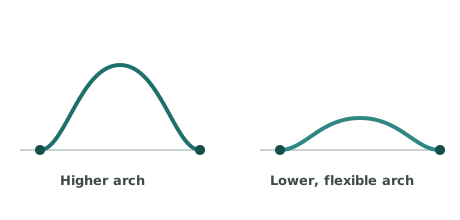
What the Findings Mean: Arch Height Does Not Equal Foot Strength
Clinical ReferenceMany of the world's fastest sprinters and endurance runners have low or flat arches. A low arch that possesses strong intrinsic foot muscles and good ankle mobility often functions far better and sustains fewer injuries than a high, rigid arch that cannot absorb ground impact. Focus on how your feet perform and feel, rather than what they look like on a footprint.

What We Can and Cannot Conclude
Systematic ReviewMedical evidence does not support using rigid arch supports to 'prevent' future back or knee problems in people whose flat feet cause no discomfort. Support should be applied when there is a clear symptom or high-volume fatigue need, not as a blanket prescription for an aesthetic foot shape.

Everyday Habits & Practical Support for Tired Arches
Clinical TrialIf your flat feet feel fatigued after long days on your feet, these evidence-supported strategies can help: • The 'Short Foot' Exercise: While sitting or standing barefoot, keep your toes flat on the floor and gently draw the ball of your big toe toward your heel without curling your toes. You will feel your inner arch actively lift and engage. Hold for 5 seconds, repeating 10 times daily to strengthen intrinsic arch muscles. • Calf & Achilles Mobility: Tight calf muscles can force the foot into greater midfoot collapse during walking. Perform gentle straight-leg and bent-knee calf stretches against a wall for 30 seconds on each side. • Choose Footwear with Torsional Stability: Test shoes by gently twisting the sole; avoid shoes that twist easily like a dishcloth. Look for a stable midfoot bridge and a firm heel counter. • Supportive Insoles for Standing Shifts: If you stand on concrete or hard flooring for hours, a cushioned insole with contoured arch support helps redistribute peak pressure and reduces muscular strain.

Frequently Asked Questions About Flat Feet
Clinical ReferenceQ: Can flat feet be corrected or rebuilt in adults? A: In adults, the skeletal architecture of a flexible flat foot is permanent. However, you can significantly improve muscle strength, dynamic stability, and walking comfort through targeted exercises and supportive footwear. Q: Do flat feet automatically cause knee or lower back pain? A: Not necessarily. While flat feet can influence the kinetic chain, many people with flat feet never develop knee or back discomfort. Pain typically occurs only when muscle endurance or joint mobility is insufficient for the physical demands placed on them. Q: Should I wear arch support insoles if my flat feet never hurt? A: If your feet are completely pain-free and experience no fatigue during daily activities, clinical guidelines do not recommend forcing arch supports into your shoes. Q: What is the single best exercise for flat feet? A: The 'short foot' exercise, combined with single-leg balance drills and calf raises, has the strongest evidence base for strengthening the tibialis posterior and intrinsic foot stabilizers.
When to Consult a Healthcare Professional
Clinical ReferenceSeek medical evaluation if you notice: an arch flattening rapidly on only one foot while the other remains unchanged; severe pain or swelling along the inner ankle tendon behind the medial malleolus; difficulty rising onto your toes on one leg; or rigid stiffness where your foot cannot be gently manipulated into an arch.

Summary Takeaways
Clinical ReferenceFlat feet are a natural, common anatomical variation. If your feet are comfortable, you can move with complete confidence. If you do experience arch fatigue during heavy standing days, simple strengthening routines and targeted insole cushioning can provide reliable, everyday comfort.
Sources
- Raj MA, et al. Pes Planus (Flat Foot). StatPearls / National Library of Medicine (2023).
- Hawke F, et al. Custom foot orthoses for the treatment of foot pain. Cochrane Database of Systematic Reviews (2008;3:CD006801).
- Kulig K, et al. Nonsurgical management of posterior tibial tendon dysfunction with orthoses and exercise. Journal of Orthopaedic & Sports Physical Therapy (2009;39(1):12-21).
- Evans AM, Rome K. A Cochrane review of the evidence for children's foot orthoses. Journal of Foot and Ankle Research (2018;11:2).